Sunday, 10 March 2013

Proteas' Steady Downfall in T20 Cricket


It's a fact -The Proteas field a better Test side than in T20 and One Day Internationals. This might sound fantastic to some patriotic South African cricket followers; that the Proteas take their Test cricket seriously, but it still doesn't hide the obvious fact that it's within the T20 and ODI Internationals that championships of nobilities are won.

So what could be the problem with our limited overs squad? What could be the reason or purpose in which led the Proteas to home series defeats against New Zealand in the ODIs and Pakistan in the T20s? The captaincy duties seemed to overwhelm Francois du Plessis in the recent T20 series defeat to Pakistan. Du Plessis was given the T20 International captaincy on a permanent basis despite him having only played less than 10 T20 International matches for the Proteas. This decision was undoubtedly a surprise to cricket analysts’ with him not having much if not any captaincy experience in this format of the game with his domestic team –the Nashua Titans. No matter how you project du Plessis’ captaincy situation in different angles, argue the fact that he’s a team leader or show off his T20 domestic and IPL stats –in conclusion the decision of him being given the T20 captaincy is appalling. There’s no reason why AB de Villiers can be South Africa’s ODI captain but not the T20 captain –especially in this time of need where the Proteas desperately are in need for an experienced T20 captain.

Highveld Lions’ Quinton de Kock has had a marvellous streak with the bat of recent. Opening his T20 RAM Slam T20 Challenge account with an unbeaten 126 against the Cape Cobras in Potchefstroom then scoring 47 in both clashes against the Nashua Titans and Chevrolet Warriors simply suggests the young talented wicket-keeper batsman should be utilized a little more efficiently in the Proteas squad. There was no reason why de Kock couldn’t open the batting with Henry Davids in the 2nd T20 match; leaving AB de Villiers in the middle order to stabilize the batting order. The fact that de Kock went on to score a well fought 65 runs in the warm-up game for the South African Invitational XI against the Pakistanis is even more of a mystery why he didn’t feature in the 2nd T20 International against Pakistan on March 3. With de Villiers opening the batting, in an inexperienced batting line up creates instability in the middle order –which then leads to an inconsistent flow to create genuine partnerships.

However the Proteas management can’t be blamed for introducing players who have performed in domestic cricket into the Proteas set-up. But that doesn’t mean that they should now have an influx of new breeds into the T20 squad. Creating a revolutionary team for championships in a certain format takes time –at most several seasons. The fact that the Proteas have an untouchable Test team is evident that their starting 11 is never tampered with unnecessarily. Jacques Kallis still plays IPL cricket in India for the Kolkata knights. Why can’t he play for his national team? We understand the necessities of him taking a break off cricket now and then; but the looks of recent performances by the Proteas –They dearly need him to be part of an inexperience Proteas T20 top order line-up. With that been mentioned, the introduction of new capped players should be done in an environment where its atmosphere is surrounded by senior players. 

Kyle Abbott’s T20 International debut against Pakistan wasn’t the most illustrious simply because he didn’t have a senior seam bowler guiding him through the different phases he would encounter with playing in the highest level of the game. If Dale Steyn were to have played (since Morne Morkel was injured) things might have been different. Not because of Steyn’s ability to put the Proteas in a commanding position, but his influence in a player like Abbott who in return –might have put the Proteas in a commanding situation against 95 runs-victorious Pakistan outfit on that tragic Sunday of March 3.

-Mandilulame Manjezi
@JizzyJakesTheIn        
   

Wednesday, 13 February 2013

I Want To Play County Cricket!


“I want to play County Cricket" says a young cricketer who hails from the small town of Port Alfred.
Siphe Gift Mzaidume suddenly found himself playing in the Minor Counties cricket league in England for Oxfordshire and Holmesdale.

The 23-year-old seam bowler stresses that just like South African born but English capped international cricketers, Jonathan Trott and Craig Kieswetter, he decided it was time to leave South Africa and pursue a professional cricketing career elsewhere. Mzaidume made his decision after coaches and selectors in both Border and Eastern Province cricket unions started doubting his cricketing ability during his development years. Although he urges that one should not walk away from their troubles, he advises young upcoming cricketers in the country to never give up on their dreams of playing cricket professionally.
 
Mzaidume’s passion for the gentleman's sport started on the partially-green cricket field of Port Alfred High School, A small fry in the Eastern Cape sporting high school scene. Whilst in Port Alfred, he obtained Eastern Province (EP) U13, U15 and U17 cricket colours. "Suddenly the EP coaches didn't want to select me for the EP U19 team in my matric year" says Mzaidume. But fortunately for Mzaidume, Border cricket agreed to grant him a chance for the Border U19 cricket trails.

He stunned the coaches present at the trials and saw himself soon playing for the Border U19 and Border Academy side for two years. But this wasn't enough. Since Border Cricket officials had ruled him as an average player, Mzaidume started thinking ahead by planning to further his cricket career.    
Mzaidume knew that he was worth more than just club cricket, where at the time represented the Old Selbornian outfit based in East London.  The young man was hungry to play professional cricket.

Mzaidume managed to get into contact with the Hampshire staff in England hoping somehow he would get in contact with also South African born cricketer, Kevin Pietersen.  After some patience and persistence, Mzaidume finally got into contact with Pietersen. Surprisingly Mzaidume's counterpart in England was none other than now Chevrolet Warriors all-rounder, Ayabulela Gqamane. "Aya [Gqamane] was also in the same shoes as me at the time.
"The Border Cricket Union were not giving us anything promising nor lucrative, so we decided to leave for England that year.  We kept each other in contact of our performances on a weekly basis. Aya got home-sick and ended up going back to South Africa." said Mzaidume while reminiscing about the early days in the cold English weather with his former Border teammate.

Mzaidume explained that he's got a year and a half left until he's legible for county cricket.
He recently toured Port Elizabeth with the Northamptonshire second side to play in pre-season games against the Warriors and a few other local teams. The English clearly see something in Mzaidume the South Africans were not.  His recent performances on the cricket field are the main contributors to all the success thus far. After his first tough season in England, Mzaidume stood strong, obtained 43 wickets in the second season, 45 wickets in the third and 47 wickets in the fourth.  The South African-born, now overseas wonder-kid also made raves in Melbourne, Australia where he recently picked up match figures of 9-47 in 20.4 overs for the East Malvern Tooronga Cricket Club. 

He'll hope to surpass the 50 wicket-barrier when he returns back to England from his winter-break later on this year. Mzaidume gives credit to his father and the rest of his family for his current success. “It was my desire to make dad proud for all the sacrifices he had made for my brothers and I. "My dad would drive me from Port Alfred to East London for cricket every time I had to attend training, and then drive would drive me back in the late evening. Just the one trip to East London from Port Alfred is over 100 km. He really believed in me. That belief he had shown in me was one of the reasons I decide to look for opportunity elsewhere."

-Mandilulame Manjezi
www.jizzyjakes.blogspot.com
@JizzyJakesTheIn

Saturday, 19 January 2013

The Tsolekile-de Villiers Saga


MANY people didn’t expected Highveld Lions Wicket-keeper batsman, Thami Tsolekile to be dropped from the South African squad –including Tsolekile himself concurs his franchise coach, Geoffrey Toyana. “Thami was very disappointed to hear that he had not been selected for the New Zealand tour to South Africa -especially after he was promised to play. But you know Thami, he’s a fighter and I can assure you he shall keep pushing the boundaries.” said Toyana.

After being promised by Cricket South Africa (CSA) convenor of selector, Andrew Hudson, to take over the glove duties in the Test series against New Zealand, Tsolekile was astonished to have not found his name in the South African Test squad to play the Black Caps. Knights and Titans batsmen, Dean Elgar and Jacques Rudolph, were still kept in the Proteas Test squad despite them both failing in Australia when given a chance with the bat.

The two batsmen had scores of 43, 9 not out and 9, 77 respectively in their recent Sunfoil Series matches coming back from their tour of Australia. Elgar grafted 21 runs off 52 balls in South Africa’s first innings against New Zealand in the first Test match; then scored a beautiful century in the second and final Test match against the Black Caps at St Georgies Park, Port Elizabeth. Tsolekile scored an unbeaten 88 against the Warriors and 46 against the Knights in that similar time frame as Elgar and Rudolph.

CSA selectors simply don’t have confidence nor are they supportive with Tsolekile’s abilities with the bat despite him relentlessly producing the goods for the Lions outfit. This also forms speculation around Tsolekile’s sudden CSA contract when he had not yet played for the Proteas since 2005. When Neil McKenzie’s international career was resurrected in early 2008 thanks to good knocks playing for the Lions, he took his golden opportunity by scoring 226 runs and obtaining the highest partnership record for the first wicket of 415 runs, along fellow opening batsman Graeme Smith against Bangladesh. He then scored an unbeaten 155 against India in Chennai then followed it up by an important and very patient 138 runs off 447 balls at Lords against England in 2008. McKenzie had scored 1050 runs in the calendar year of 2008.

After a dismal series in Australia and constantly being exposed with the new ball by the Australian fast bowlers, McKenzie was dropped from the Test side –despite scoring a desperate 59 runs not out in Melbourne. McKenzie was never looked at again for Test cricket selection. Rudolph was blessed with the same opportunity similar to McKenzie when he was selected to play for the Proteas in the summer of 2011. Since then Rudolph has played in 13 Test matches and has only managed to score one century and three half-centuries against Sri Lanka, New Zealand and England. Many could argue that McKenzie deserved more time, just as Rudolph, especially with the figures he had produced with the bat in just 2008.

Many wicket-keepers speak of the profession in a prestigious manner. They’re dedication to the art of wicket-keeping is unbelievable. All these wicket-keepers started their cricketing careers with the gloves from high school cricket then grow up with the skill into professional cricket. AB De Villiers’ journey into the keeping duties is simply a mockery towards the art of wicket-keeping. Picking and choosing which format of the game you want to take wicket and not take wicket is a spit on the face for those other wicket-keepers who work tirelessly on their keeping skills. You can’t compare De Villiers with New Zealand wicket-keeper, Brendon McCullum, because he initially is a wicket keeper. So if he feels that the gloves are affecting his batting in certain formats of the game, he can by all means drop the gloves and instead focus on his batting. He is a wicket-keeper batsman –not a part-time wicket-keeper batsman like De Villiers. If De Villiers is serious about wicket-keeping then he has to take the gloves for all formats of the game just as Mark Boucher had done.  

So what are the verdicts that come out of these statistics? Firstly is that it’s not a matter of coaches or the selection panel being racist as people are quick to assume, but a matter of inconsistency within the South African selection panel. It is evident to similar statistics to these that player selections for different players are biased. Secondly, it’s vividly evident that certain players in the national team just do as they please and the management team will in a posh manner accept any demands made by these players. According to Herschelle Gibbs’ book, To the Point, similar tales are highlighted in this article exist within the South African cricket camp.   

What’s now done certainly cannot be undone. CSA have already granted Tsolekile a CSA contract, despite the selectors not eager to use his wicket-keeper services for the national side. Arguments and debates won’t solve Tsolekile’s problem. Tsolekile has to be given a chance if he continues with his form in domestic four-day cricket. And when he’s given the opportunity, De Villiers has to play as a batsman. It’s that simple. It’s unquestionable that Tsolekile has the best wicket-keeper skills in South Africa at the moment. Statistics of recent seasons and performances prove it.


-Mandilulame Manjezi
@JizzyJakesTheIn
www.jizzyjakes.blogspot.com


Tuesday, 8 January 2013

Young Gems Are All Set To Sparkle

[This is my first newspaper article -20 December 2012 for the Daily Dispatch. A very special moment for me, achieving such in my 1st year of journalism. The Dispatch is only available in the Eastern Cape so many people in other provinces weren't able to read the article. Well here it is. Hope you enjoy it. :)]

IF you ever have the opportunity to enter the Buffalo Park Cricket Stadium’s reception office in East London, being conscious of it or not, your curiosity will instantly kick in once you see the trophy cabinets.

On the wall of fame, you’ll discover an array of cricket players and coaches originally from the Border Cricket Union on display.
 One will see Makhaya Ntini, Raymond Booi, Angelique Taai’s
framed portraits in their South African blazers.
 A sense of pride will instantly flow through your veins like a witchdocter being hit by an epiphany.

But the names mentioned here are just the minor successes Border Cricket have managed to propel to national stardom in recent years.
 The current crop of black cricketers in Border Cricket –ranging from school to professional level –the future seems brighter than ever for South Africa’s historical cricketing region.

Already this year Border Cricket have witnessed some brilliant individual performances.
Border amateur opening batsman Vuyisa Makhaphela’s innings of 165 of 501 balls against KwaZulu-Natal Inland was a sign of a batsman steadily emerging.
 Border U19 left-arm seam bowler, Ngazibini Sigwili, has shown tremendous progress.
 His 6/25 against Namibia U19 in the schools inaugural Coca-Cola Khaya Majola Cricket Week, proved to both Border coaches and selectors he’s truly a talent ready to blossom.

The Border Cricket Union has set up various programmes to develop and maintain Border talent from the time they leave school.
 Border Cricket coaches’ manager, Deon Muller, explained passionately how the current system works to assist black cricketers in the region graduate to provincial and hopefully international cricket honours.
 “We have academies put in place for all the various regions that fall under Border Cricket,” he said.


 “People have asked me questions about why a player like Mkhululi Calana is not playing for the Boder amateur side despite him playing for the SA Schools’ Colts last year.
 “This is simply because we are still working with him at one of our various cricket academies.
 “We want to make sure so that when he gets the chance to play amateur cricket, he’s ready and not just pushed into the set-up when he’s not prepared for the type of cricket played at a higher level.

These academies Muller speaks about are training camps that take place throughout the year to monitor the consistency and form of young cricketers.
 Academies for cricketers still in school usually train between May and September.
 Academies for potential amateur cricketers take place in the latter end of the year from September to next year April.

Border Amateur coach, Frank Plaatjes, commends Border Cricket Union for its consistent work and dedication in ensuring black cricket transformation in the region.
 “Some coaches around the country don’t have faith in their black cricketers but our approach is different,” he said.
“In the past few decades Border Cricket has shown its outmost dedication towards our black players and in return they have shown their appreciation by excelling far beyond of what is expected of them.”

-Mandilulame Manjezi
 @JizzyJakesTheIn

Wednesday, 19 December 2012

Geoffrey Toyana The Lion King


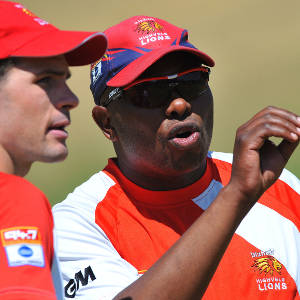
It’s so ironic how the story of the Highveld Lions, and the introduction of their new and first black South African franchise cricket coach, Geoffrey Toyana, is such a similar tale with the historical story of The Lion King. From what I recall in the tale, once Simba managed to overthrow this evil uncle, Scar, all peace and harmony welcomed his kingdom. But it wasn’t easy as all sorts of obstacles had to be overcome. The same goes for Toyana. It took some fight coming from the Soweto-born and former Titans batsman, dedication to better his ability as a coach and most importantly passion –for Toyana to get to his sudden minor success of recent.

I had the privilege as a net bowler (during the CLT20 tournament) to train with the Lions franchise team and experience how it feels to be a ‘cub’ under Toyana. The first element I saw and really enjoyed to witness was the mutual respect from players to coach, and vice-verse. Toyana seemed to be a father-figure to the young men in red and white. I saw him making jokes with the 19-year-old batsman, Quinton de Kock, while playfully doing some boxing with talented batsman, Temba Bavuma on the side. It seemed to be a very fun camp. When it was time for a team talk, the boys would then ‘switch on’ and patiently listen to instructions while the king would go on preaching a lecture of importance. Stephen Cook did not feature in the CLT20 tournament, but king Toyana was much eager to give him more than enough batting time in the nets.

It’s really frightening how a season ago the Highveld Lions were an average outfit and this season, the Gauteng team are now such a powerful unit. Since the appointment of Toyana, not only did the Lions achieve the impossible (reaching the finals of the CLT20 tournament and the One Day Momentum Cup) but the atmosphere within the team has also changed. Young players in particular are picking their hand up and are either scoring match-winning runs or taking much needed five-wicket hauls. Every individual seems to be doing their deed towards the success of the team by surpassing minimum requirements that are expected of them –in all formats of the game.   

A team without a lot of superstars or ‘big names’ in the squad (except for former test batsman Neil McKenzie), the Highveld Lions have achieve much success in their little time spend with their new coach king Geoffrey Toyana. The very near future looks bright for Toyana and his crop of young cricketers if they keep their current success consistent. Much praise has been made for the new black franchise coach. All who know him well know that he isn’t threatened at all but any type of pressure.

-Mandilulame Manjezi
@JizzyJakesTheIn


Saturday, 8 December 2012

My Journey Through Mamelodi Cricket


It’s a really sad day today. Not because of the overcast, gloomy weather that’s hovering over the beloved township of Mamelodi, but because this is my last Premier League cricket match for a team that’s not just my cricket team –but one team that has become a family to me.

I’m driving to the cricket ground with my very close friend and former first-class cricketer, Mpho Selowa, who relentlessly keeps reminiscing ways to make me look like a fool when I soon get to bowl at him. He plays club cricket for Tshwane University of Technology (TUT); against us today, Mamelodi Cricket Club. He’s a very talented black wicket-keeper batsman this Selowa boy. Sadly he’s now talent that has been wasted because of politics and certain agendas including his character throughout his career.

He’s not the only cricketer though –I could make a list of all the cricketers I’ve met in my very young career, that in some point of their lives have represented South Africa in cricket whether it is school or university cricket –but struggle to even obtain a first-class cricket contract.

Mpho and I finally get to the Mamelodi Oval and immediately start greeting everybody that’s in sight. Some are players I played academy cricket with, some are school youngsters that I’ve heard about, but only see them today for the first time. A few are people I’ve never really liked, simply because they think they’re better than the game and better than other cricketers.

 The weather is really not looking good right now and slowly starts to pour harder onto the historical ground. It now starts to sink in slowly that I won’t have an opportunity to play my last game on the field that has taught me so much about not only cricket, but life and family as well.

Life in this cricket club though was never this peaceful and harmonious. In the two seasons I had spent here, I noticed players being spiteful, jealous and bitter amongst each other. One would blame it on the other player or on the Northerns Cricket Union (NCU). But I later learned that the major problem with the club and why we seemed to face relegation each year was one thing –a lack of black consciousness. We had this attitude that this gentlemen’s sport as it’s famously called was a white/Afrikaner man’s sport.

However in my last season spend here, thing started changing. We got a new administrator in former Northerns cricketer, Patrick Nkuna, and a new coach, Sello “Bra Cry” Sebola, who was indeed very radical in his approach and very enthusiastic in coaching the beautiful game to us. These two men made sure that all players understand the structures of selection by making us challenge each other for first team positions. A 26-year-old would feel so disappointed having lost his place to a young hungry-winning schoolboy cricketer.


I doubt a lot of people can imagine how privileged I was to be sharing the same changing room with cricketers such as Abram Ndlovu and James Mokonyama who once played for the Titans, Thabang Khumalo and Lerato Kgoatle who seem to be the future of black batsmen in Northerns Cricket, if they careers are treated with immense responsibility by the NCU. These cricketers are hugely respected throughout the entire country by professional and amateur cricketers. Listening to their stories, words of wisdom and guidance, such could only be found at Mamelodi Cricket Club –were cricket is more than just a game.


-Mandilulame Manjezi
@JizzyJakesTheIn

Friday, 30 November 2012

Tough Selections Ahead


The Australians must be fuming with the South African batsmen injuring themselves –then having their replacements score match-saving innings. For the second time now that South Africa have toured Australia, they have had their in-form number six batsman injured, replaced by a debutant –and having him securing the ship from being drowned by the Australian bowlers with their skilful pace and “weapons of mass-destruction”.

Gary Kirsten was the head coach for the Indian team before being head coach for the Proteas. But even with the extensive amount of talented players he had to choose from in India, doesn’t compare the nightmares he and the rest of the selection panel have to face coming towards the last Test match of the series which starts on Friday November 30.

I feel that Jacques Rudolph has been given enough time to prove himself –and hasn’t quite put his hand up since his readmission to the Proteas Test side. I’m personally a huge Rudolph fan, but at the same time, I’m a true believer in being in top cricket teams with consistent performances and not average –especially when a cricketer has got the talent and capability to do almost the “impossible”. Question marks now linger around cricket discussions on coffee tables as to who shall replace Rudolph if Kirsten and his Test captain, Graeme Smith, decide to execute that brave decision.

Dean Elgar is a solution but many feel that he hasn’t played a lot of 4 day cricket this season with many of the Chevrolet Knights’ matches being called off by rain. Not only that, but having so much in-experience in your batting order (Elgar and Faf du Plessis) is a hole that could easily be exposed –despite Du Plessis’ success at Adelaide. We need AB De Villiers! It’s very evident that he’s not quite in himself with the bat. May this be because of the glove-work getting into the way? We all can sit and debate that –but only he knows the honest answer to that question. De Villiers was once quoted saying that he’s not really eager in taking over the gloves from Mark Boucher. That may have been a while back –but there was still some doubt coming from him in that answer. Other wicket-keepers who have done the job from high school cricket until their professional careers have talked about wicket-keeping with such passion and gusto –not as a burden and “team-balance” as how De Villiers has spoken about it.

In conclusion, when the selection panel pick their squad to tour a country they have to have every faith in the players they pick. I recall Lonwabo Tsotsobe celebrating with the rest of the team when Hashim Amla scored the winning runs to secure the Proteas a Test series victory over Australia at home in 2008/09. For that time (and maybe longer) till the Proteas’ tour of England earlier this year, Tsotsobe has only played five Test matches and has toured with the South African Test Squad in all their tours if not most. In this time span, he has witness other seam bowlers such as Marchant de Lange and Vernon Philander surpass him in the starting 11 –despite him being in the squad for longer and selectors labelling him as “plans after Makhaya Ntini”. The same thing seems to be happening to wicket-keeper Thami Tsolekile. From what it looks like on the side-line, it’s very doubtful that Tsolekile will be given a run any time soon. We just shouldn’t be, or even act surprised when we see him being dropped without a valid reason.


-Mandilulame Manjezi
@JizzyJakesTheIn